

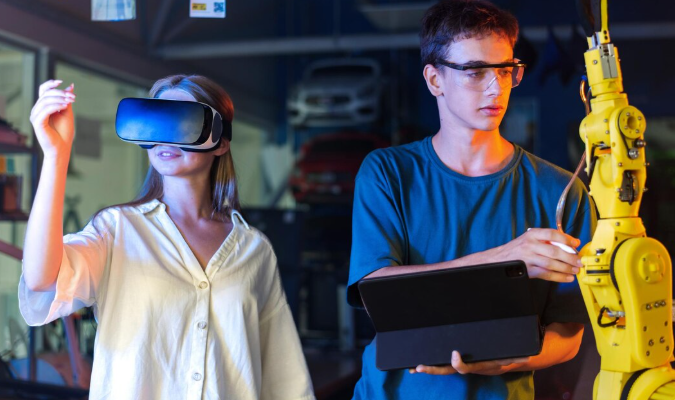
The doors of a low, windowless building in Silicon Valley don’t open on their own. Access badges are examined twice. The air inside is kept abnormally cool to control heat, and rows of machines hum at a constant pitch. Engineers move silently between terminals, looking at dashboards that monitor something hard to see—models that are constantly learning, evolving, and getting better.
Some of the most potent artificial intelligence systems are being developed here. And more and more, very little is said about it.
| Category | Details |
|---|---|
| Industry | Artificial Intelligence Research |
| Key Players | OpenAI, Google DeepMind, Anthropic, Meta Platforms |
| Emerging Labs | Secret Labs Inc, DeepSeek |
| Core Focus | Large language models, multimodal AI, agentic systems |
| Key Technology | Massive compute, proprietary datasets |
| Trend | Increasing secrecy in AI development |
| Infrastructure | Data centers, specialized chips |
| Debate | Transparency vs competitive advantage |
| Risk | Safety, accountability concerns |
| Reference | https://www.wired.com |
In the past, businesses like OpenAI and Google DeepMind shared their methods and datasets with the scientific community by publishing comprehensive research papers. This transparency sped up development. However, something has changed. New models come with well-curated technical summaries and polished demos, but they omit important information about how they truly operate.
This silence might be deliberate. These systems are costly to construct, requiring energy, specialized chips, and enormous amounts of data on a scale more akin to industrial projects than software development. Giving away too much could give rivals an advantage.
There is a new trend: models that are more capable tend to have less transparent origins. Even so-called open models frequently only disclose portions of their architecture or training data. The industry seems to have shifted from collaboration to containment, protecting previously more freely shared insights.
The emphasis at more recent companies, such as Secret Labs Inc., has shifted to systems that not only react but also remember—models that can create long-lasting context, learn from interactions, and change over time. There is a discernible shift in tone when watching these systems in action. Developing something that functions almost like a continuous intelligence is more important than providing answers to questions.
Labs like DeepSeek are racing to develop similar systems in parts of Beijing and Shenzhen, frequently with fewer resources but surprising efficiency. A quiet reevaluation of what is truly needed to compete has been compelled by some models, which are said to have been developed at a fraction of the cost of their Western counterparts. The tension between speed and secrecy, between scale and inventiveness, is difficult to ignore.
In contrast, the physical infrastructure in locations like Mountain View speaks for itself. Stretching across industrial zones, data centers are stocked with hardware from companies such as Nvidia. With thousands of GPUs operating in parallel and using enormous amounts of electricity, the scale is overwhelming. The buildings appear unremarkable from the outside. They are forming systems inside that affect everything from creative work to search results.
There is a sense that algorithms are no longer the only factor in the true competition. It concerns resources, including talent, data, and computation, and who has control over them. However, the secrecy raises difficult-to-answer questions.
Concerns about the field straying from its scientific foundations have grown among researchers. Results are more difficult to confirm when methods are not shared. Biases are more difficult to identify when datasets are kept hidden. It’s still unclear if this change will slow down development or just concentrate it in a small number of businesses.
There is an odd duality as you watch this play out. On the one hand, AI systems are becoming more apparent as they are integrated into products and influencing day-to-day interactions. However, the mechanism underlying them is becoming less clear. The results can be found everywhere. The sources are becoming more and more elusive.
Additionally, there is the issue of control. Governments are starting to pay more attention, starting programs to safeguard domestic AI capabilities and control advancement. Regulation, however, proceeds slowly. The labs have a fast pace. As models become more proficient, that disparity seems to be growing.
It’s difficult to ignore the ambience that surrounds these locations. Not merely secrecy, but a subdued intensity. Systems are constantly operating, engineers are working late, and progress is measured in small steps that eventually add up to something significant.
A single breakthrough never makes an announcement. Rather, the alterations build up. A marginally superior model. a quicker reaction. A system with slightly better memory. Every step seems insignificant. When combined, they transform what is conceivable.
Where this trajectory goes is still unknown. Some people think that these labs are creating instruments that will enhance human potential, simplifying tasks and increasing the accessibility of concepts. Others are concerned about power concentration and systems that are challenging to comprehend and even more challenging to manage.
Both points of view seem plausible. It seems almost normal to stand outside one of these buildings and watch workers badge in and out. No big reveal. There’s no indication of what’s going on inside. It’s just another workday, another office.
However, something is being constructed inside—quietly, steadfastly—that could define the production and dissemination of knowledge itself. And it’s not just the technology that stands out. It’s the extent of what we can see.
