

For the past ten years, Steve Fowler and Sam Wilson have lived across from one another on the same peaceful East Memphis avenue. They have been performing together on Beale Street for twenty-one years. That street changed on Thursday. In the center of it was a line. The 8th Congressional District, which extends hundreds of miles into central Tennessee, is where Fowler, a white voter, currently casts his ballot.
Wilson, a Black voter, casts a ballot in the 9th, which winds around the southern border before inexplicably bringing together Nashville’s affluent suburbs. They live next door. They are no longer the same congressman’s constituents.
| Topic | Tennessee Congressional Redistricting — 2025 special session redraw |
| City Affected | Memphis, Tennessee (Shelby County) |
| Previous Configuration | One Democratic-held district (TN-9) covering most of Memphis |
| New Configuration | City split across three GOP-leaning districts |
| Triggering Event | U.S. Supreme Court ruling on April 29, 2026 weakening Section 2 of the Voting Rights Act |
| Tennessee Legislature | Republican supermajority; sponsored by State Sen. John Stevens |
| Legal Challenges | Filed by Democrats, civil rights groups, including the National Democratic Redistricting Committee |
| Civil Rights Context | Memphis is home to the National Civil Rights Museum at the Lorraine Motel |
| Grassroots Organizers | Equity Alliance, Memphis for All |
| Population Impact | Majority-Black city of roughly 620,000 residents distributed into mostly white, rural districts |
| National Comparison | Similar redraws underway in Alabama, Florida, Louisiana, Mississippi, South Carolina |
It’s the kind of detail that, until you stand on the block, seems made up. There’s a feeling that maps like this are intentionally meant to be abstract, so those who create them never have to imagine two men with guitar cases leaving facing houses on a Tuesday morning. Tennessee is a conservative state, and its delegation should reflect that, according to Republican state senator John Stevens, who carried the bill. That is one way to put it. Another is that Memphis no longer has its own congressional district for the first time in almost a century, long before the Voting Rights Act.
It wasn’t an unexpected redraw. The portion of the Voting Rights Act that had required mapmakers to demonstrate they weren’t diluting the votes of racial minorities for sixty years was drastically narrowed on April 29 by a conservative Supreme Court majority. Republican legislatures in the South began drawing new lines in a matter of days. Tennessee was the first to arrive. Due to President Trump’s pressure on Texas earlier in the cycle and California’s retaliatory redraw on the Democratic side, Alabama, Florida, Louisiana, Mississippi, and South Carolina are all circling the same playbook. It’s still unclear if any of it makes it through the legal system. Several of the legal experts I’ve spoken with have been quoted in the local Memphis press, and they all sound dejected.
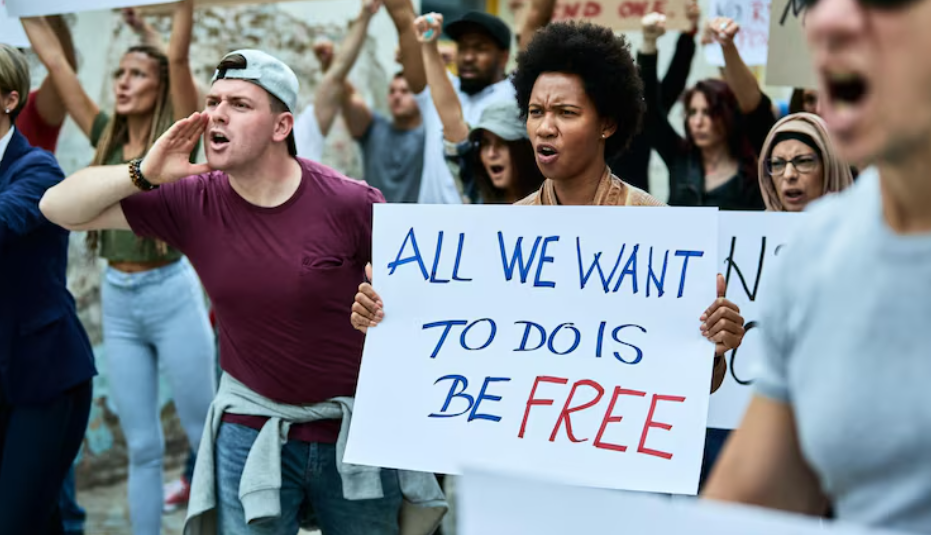
The symbolism and the fact that the rest of the nation is only now paying attention are what make Memphis feel unique. The federal agents Trump sent in this fall, the safety narratives promoted by suburban lawmakers, and Nashville’s regular presumption that Memphis is a problem to be managed rather than a place are just a few examples of the state-versus-city dynamic that has been tightening for years. It’s difficult to ignore how late the national outcry is coming as you watch this develop. When I asked Wilson, he wasn’t even shocked. “It’s a hustling community,” he remarked. “We’re going to make ends meet for our families.” Instead, he discussed music and how difficult times in Memphis often bring out a particular kind of talent.
In any case, the protests have been noisy. As the Legislature passed the maps, people in the gallery yelled, “Hands off Memphis,” and some carried signs that specifically mentioned Jim Crow. Former U.S. Attorney General Eric Holder, who currently serves as chair of the National Democratic Redistricting Committee, presented Memphis as a pivotal point in the nation’s civil rights narrative: the city where Black people marched and lost their lives for the right to vote, and where the Rev. Martin Luther King Jr. was slain. This week, about forty locals boarded a bus at First Congo Church on South Cooper to travel to Nashville. The pushback is being coordinated by Memphis for All and Equity Alliance. “Memphis is one of the last strongholds,” Equity Alliance’s Martin Johnson stated, “and we have to hold on to our Black vote and our Black voices in the South.”
Speaking with people downtown gives me the impression that something Memphis has been carrying for a while has finally caught the attention of the rest of the nation. Putting aside doubt cycles a la Tesla, this one is more difficult to ignore because it’s a city, a map, and the location of a significant portion of the modern American narrative. None of the issues have been resolved, including whether the lawsuits succeed, whether the Supreme Court’s reasoning is sound, and whether the Nashville suburbs genuinely wish to inherit a portion of the Mississippi River. It has been decided that two men living on the same street no longer share a representative. That is a minor issue. It’s the entire thing, too.
