

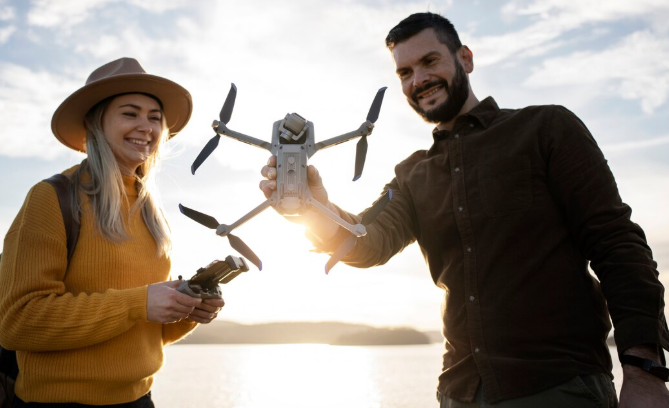
A gardener once compared the sound of delivery drones to “a leaf blower that never stops” in the backyard of a peaceful neighborhood in College Station, Texas. One spring morning, the machines materialized out of nowhere, rising above the trees with a startling electric buzz before vanishing over rooftops. The future seemed to have come early for a few weeks. The flights then slowed. They eventually came to an end.
It’s difficult to ignore the discrepancy between Silicon Valley promises and everyday reality as you watch that experiment play out.
| Category | Details |
|---|---|
| Topic | Commercial Drone Delivery Industry |
| Key Companies | Amazon, UPS, Alphabet |
| Major Projects | Amazon Prime Air, Wing |
| Industry Sector | Logistics, Aerospace, Robotics |
| Key Regulatory Body | Federal Aviation Administration |
| Early Promise | Jeff Bezos predicted widespread drone delivery by 2018 |
| Current Use Cases | Medical deliveries, rural logistics, emergency transport |
| Key Barriers | Regulation, reliability, airspace management, public acceptance |
| Reference | https://www.forbes.com |
In 2013, Jeff Bezos was sitting in a TV studio with a tiny drone prototype. At the time, the concept of small planes delivering packages in less than half an hour seemed almost absurd. Drone deliveries within five years was a daring forecast. Silently, that five-year milestone was reached. And for the most part, nothing was visible in the skies.
A few years ago, engineers watched prototype drones lift small packages into the desert air while standing close to a testing facility in rural Nevada. The drones hovered carefully before flying toward far-off landing pads. The devices functioned. For the most part. However, aviation authorities demand near-perfect results.
Only one catastrophic failure per billion flight hours can be tolerated by a commercial aircraft system. Even with their many modifications from consumer designs, delivery drones are still far from that level of dependability. The timeline is altered by that alone.
The Federal Aviation Administration and other regulators have been cautious, which has occasionally frustrated tech companies that want to grow. In many nations, drone operations beyond a pilot’s line of sight—which is crucial for extensive delivery networks—remain strictly regulated.
Another set of issues arises when people are flown over. The regulatory maze begins to resemble a wall rather than a delay when nighttime operations and congested urban airspace are added. Additionally, there is the unsettling truth of physics.
Delivery drones can’t carry a lot of weight because they are tiny, battery-powered aircraft. A three-pound package, such as a sandwich order, a prescription bottle, or possibly a phone charger, can be transported by a typical drone used in early pilot programs. For certain deliveries, that works. However, logistics firms transport billions of packages annually, many of which are too heavy for drones to handle.
A quiet epiphany occurs as one observes a test drone hovering over a suburban lawn and lowering a small box on a cable. The technology is amazing. However, the delivery truck won’t be replaced anytime soon.
Nevertheless, businesses continue to strive. Over the course of more than ten years, Amazon has refined its Prime Air project, experimenting with aircraft that resemble a hybrid of a small airplane and a helicopter. In the meantime, Alphabet has advanced its Wing division and tested drone delivery in some areas of the US and Australia.
Drone networks operated by firms like Zipline already transport blood and vaccines to isolated hospitals in Rwanda and Ghana, frequently more quickly than ground transportation could.
Drones address a serious issue in rural areas with unreliable roads. Suddenly, it makes perfect sense for a small plane to transport urgent medication across a mountain valley. Investors appear to think that these specialized applications could eventually grow into larger logistics networks. However, even hopeful engineers acknowledge that there is a huge gap between rural medicine and urban package delivery.
Residents in the Texas neighborhood where Amazon conducted tests expressed dissatisfaction over the continuous buzzing overhead. It was compared by some to a swarm of robotic bees. Others likened it to perpetually operating landscaping equipment. Concerns about privacy soon followed. Even if drones are carrying nothing more suspicious than dog treats or toothpaste, people are generally uncomfortable when they are hovering close to homes.
Given the hype surrounding drones, it seems almost surprising that there aren’t any of them when looking up on a calm afternoon in most cities today. There are helicopters, airplanes, and perhaps a news helicopter in the distance. But not as the buzzing fleets had once thought. This does not imply that the concept has failed. Maybe it’s just early.
Errors happen all the time, which contributes to the aviation industry’s slow pace. Every new aircraft system, including autopilot software, commercial jets, and helicopters, had to prove itself for years before authorities permitted widespread adoption. Drone delivery is going in the same direction, but under the intense scrutiny of the tech industry’s demands.
Observing the gradual advancement, it seems possible that drone delivery will arrive gradually rather than in a sudden swarm. This is a hospital flight. There is a supply run for a remote village. Maybe a grocery delivery in a peaceful suburb.
And perhaps one day the sky will finally buzz like Silicon Valley once dreamed.
