

On a clear morning, you will see Schipkau almost before you realize it. A partially completed lattice mast ascending into a sky that, until recently, was primarily occupied by slow-moving freight trains and coal dust. From the road, the crane next to it appears enormous, but it is somehow too small for what is being constructed. The scale has a subtly hopeful quality as well as a hint of absurdity.
It has been a long time coming, but this is Brandenburg’s wind moment. Lignite mining, a type of industry that simultaneously shapes towns, accents, and family histories, was once what bound the region together. Engineers are currently building what will be the world’s tallest wind turbine on land that once fed Germany’s coal addiction. When completed, the structure—including the blades—will reach a height of 364 meters. It’s a strange comparison, but that puts it just short of the Berlin TV Tower.
| Detail | Information |
|---|---|
| Project Name | High-Altitude Wind Turbine, Schipkau |
| Location | Brandenburg, Germany (former Lusatia coal region) |
| Total Height | 364 metres (including blades) |
| Equivalent Building Height | Roughly a 100-storey tower |
| Lead Engineering Group | GICON Group, Saxony |
| Funding Body | Germany’s Federal Agency for Breakthrough Innovation (SPRIND) |
| Estimated Cost | €20 million to €30 million |
| Tower Mechanism | Telescopic lattice mast |
| Energy Yield Advantage | Up to twice the output of standard turbines |
| Status (April 2026) | Under active construction |
| Will Become | Second-tallest structure in Germany, after the Berlin TV Tower |
Though the execution is anything but simple, the reasoning behind it is. Higher altitudes experience stronger, more reliable wind that is less affected by the lulls that affect turbines nearer the ground. The height could nearly double the energy output of a traditional onshore turbine, according to engineers at GICON, the Saxony-based organization in charge of the construction. That’s a significant figure, particularly for a nation that is still rushing to replace its gas supply from Russia and is currently dealing with additional price pressure brought on by the Iran War.
The Federal Environment Minister of Germany, Carsten Schneider, has been direct about the importance of the project. He talks about independence from places that have used energy as leverage for too long, as well as from oil and gas. These days, politicians frequently say it—sometimes a bit too smoothly. However, the words seem less practiced than usual as I stand in Schipkau and watch the lattice mast slowly rise.
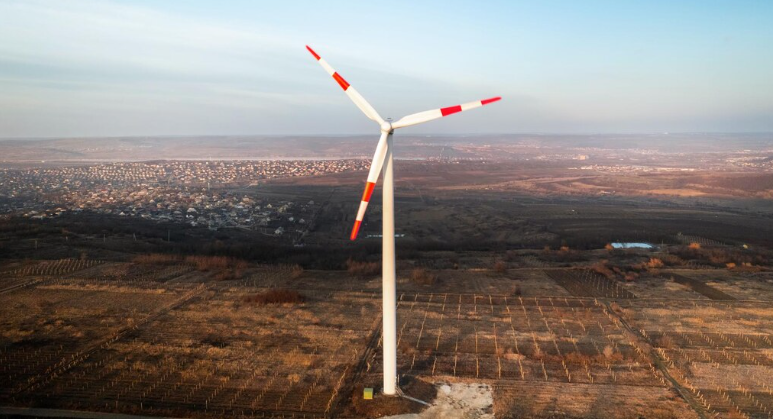
The telescopic tower is what really sets this turbine apart. The majority of turbines are constructed from the bottom up, segment by segment, and are lifted by massive cranes that soon become the limiting factor. In contrast, GICON’s design extends upward gradually, resembling a radio antenna that is pulled section by section. Professor Horst Bendix, a former GDR-era technologist whose career spanned eras most people don’t attempt to bridge, supported the strategy. You could refer to it as idea persistence. Long after others had given up on the idea, he continued to promote it.
The project might encounter difficulties. For many years, high-altitude wind turbines have been discussed, but the majority have remained in the planning stages. There are structural questions, maintenance conundrums, and aviation issues that still lack clear solutions. The federal innovation agency that funds a portion of the project, SPRIND, is aware of this; the agency’s entire purpose is to take risks that cautious investors won’t. Those wagers can occasionally be profitable. They can remain partially constructed for years at a time.
However, there’s a feeling that Lusatia is changing. The coal trains are recalled by the elderly residents. Younger ones observe a turbine. It’s genuinely unclear whether the technology can scale beyond Schipkau, and anyone claiming to know for sure is selling something. However, the mast continues to rise for the time being. One section at a time, carefully and slowly.
