

Imagine the Moon’s surface close to its south pole. It is a landscape of ancient craters and constant shadow, completely motionless, amassing something for four billion years that Earth’s magnetic field has consistently pushed away. Layer by layer, helium-3, a light isotope, becomes trapped in the regolith undisturbed as it wanders in on the solar wind. It hardly exists in usable quantities on Earth.
Approximately a million metric tons of it are thought to be up there, resting in the dust like an unreachable fuel depot. It is nearly impossible to pronounce the numbers that are tied to it aloud. As much as $3 billion each kilogram. Forty metric tons is enough to provide around 25% of the world’s yearly electricity. a trillion-dollar potential market. Additionally, there is hardly any established legal framework governing who gets to handle it first.
The businesses are already relocating. Interlune has been discreetly developing the technological and commercial framework for He-3 extraction with the support of significant aerospace veterans. Patent applications are being filed by Lunar Helium-3 Mining. Investors are paying attention in a manner similar to that of early commercial launch companies: first with skepticism, then abruptly without it.
This seems to be more than just science fiction that is completely theoretical. Even if the legislative framework required for commercialization is still only partially constructed from the 1960s, the machinery of commercialization is warming up.In an effort to keep nuclear weapons out of orbit, the Outer Space Treaty was drafted. No one was considering mining rights.
The 1967 Outer Space Treaty, which prohibits any country from asserting sovereignty over the Moon or any other celestial body, is the fundamental document in this case. It was an attempt during the Cold War to prevent space from becoming another theater of territorial conflict, and it was largely successful in that regard. However, the treaty says nothing at all about what happens when a private corporation, not a country, removes and sells stuff from the lunar surface.
In an effort to bridge this gap, the 1979 Moon Agreement declared lunar resources to be a shared human heritage and mandated the creation of an international governing body prior to any extraction. In theory, it makes sense. The fact that China, Russia, and the United States never approved it in reality tells you nearly everything about its true authority.
The 2015 Commercial Space Launch Competitiveness Act, which gave US individuals the ability to own and sell resources they take from space without claiming the land itself, emerged instead, at least on the American side. It’s a cautious legal distinction that might stand up to examination. Alternatively, a future international court might take a different stance. This idea was expanded upon by the Artemis Accords, which are currently signed by over forty nations and state that extraction is not the same as appropriation. Notably, China and Russia have not signed. It’s not a subtle absence.
It’s difficult to avoid thinking back to the early days of deepwater oil drilling as you watch this entire structure take shape: massive financial incentives, cutting-edge technology, and governance frameworks that were constantly lagging behind.
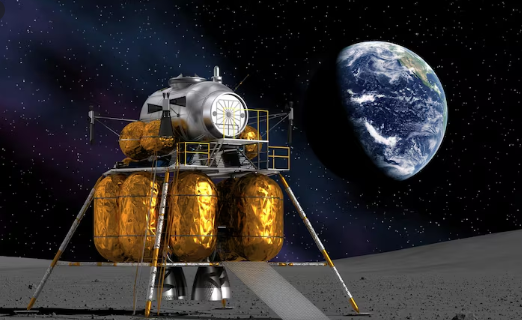
There are actual practical risks building up in this legal limbo. He-3 and water ice are concentrated near the lunar poles, which have a limited region. In the same resource-rich craters, rival enterprises, whether commercial or national, could physically and technologically interfere with one another. As of right now, there is no binding claims register, no enforcement mechanism, and no body with the power to decide those issues.
Depending on who asks, it’s still unclear if the first business to successfully extract and sell lunar helium would be hailed as a pioneer or accused of poaching. For four billion years, the Moon has been waiting. It appears that the legal system need a little more time.
