

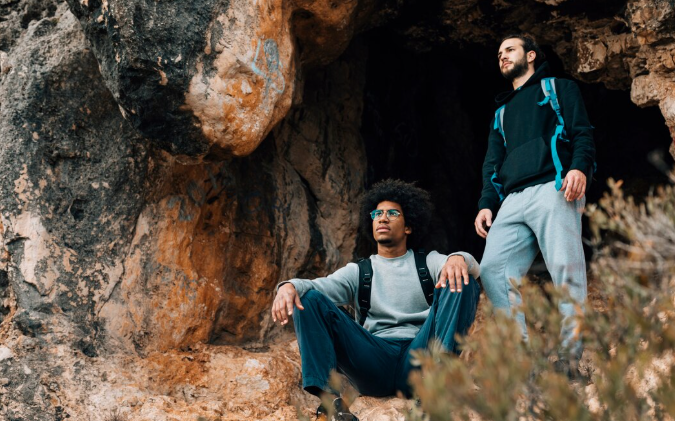
The entrance to Denisova Cave, located high in Siberia’s Altai Mountains, appears surprisingly unremarkable. Snow frequently clings to the rocky slopes outside, and a chilly wind blows through the trees.
For decades, archaeologists have been excavating there, clearing dirt from old bones and stone tools. The findings, which showed evidence of Neanderthals and early humans traversing Ice Age environments, seemed familiar for years. Then, in 2008, a tiny object that could fit on a fingertip was discovered.
| Category | Details |
|---|---|
| Ancient Human Group | Denisovans |
| Discovery Year | 2010 |
| Discovery Site | Denisova Cave |
| Key Fossil Evidence | Finger bone, teeth, mandibles, and later a skull |
| Closest Relatives | Neanderthals and Homo sapiens |
| Major Fossil Discoveries | Xiahe mandible (Tibet), Laos tooth, Harbin “Dragon Man” skull |
| Estimated Existence | Roughly 200,000 – 30,000 years ago |
| Genetic Legacy | Up to 5% Denisovan DNA in some modern populations |
| Unique Adaptation | High-altitude gene variant helping Tibetans survive thin oxygen |
| Reference Source | https://en.wikipedia.org/wiki/Denisovan |
It was a piece of a young girl’s pinky finger from tens of thousands of years ago. At first, the bone appeared unremarkable. One more fossil in a long line. However, the outcomes were peculiar when geneticists extracted DNA from it. The genome was different from that of contemporary humans. Neanderthals didn’t match either.
The scientists became aware that they were looking at proof of a previously unknown human species.
That moment, announced in 2010, introduced the world to the Denisovans. The peculiar thing is that we really don’t have much. a bone in the finger. Some teeth. Later, a tooth found in Laos and a jawbone from Tibet. That was practically the whole fossil record of a whole branch of humanity for many years.
It’s difficult to ignore that fact. Once dispersed throughout Asia, the entire ancient human population was reduced to pieces that would fit in a tiny museum drawer. However, the DNA reveals a far more comprehensive tale.
According to genetic analysis, Denisovans split off from Neanderthals between 400,000 and 500,000 years ago, making them close cousins. Sometime after modern humans left Africa, they also came into contact with and interbred with our own species, Homo sapiens.
There are still remnants of those interactions. People may have up to 5% Denisovan DNA in some populations, especially in Melanesia and parts of Southeast Asia.
This implies that remnants of Denisovan biology are still present in living things, which is subtly amazing.
There’s one gene, in particular, that scientists talk about often. A variation of the EPAS1 gene, which helps control oxygen in thin mountain air, is present in people who live on the Tibetan Plateau. Eventually, scientists were able to link Denisovans to that adaptation.
To put it another way, a long-extinct human species might still be assisting humans in breathing at high altitudes. It seems almost poetic. Modern genetics echoes ancient survival tactics.
However, the Denisovans remained oddly anonymous for over ten years following the discovery. Despite having a thorough understanding of their DNA, scientists were largely unaware of their true appearance. The skull then appeared.
The fossil was discovered decades earlier in the northeastern Chinese city of Harbin. It had been buried during the war and had been forgotten for many years. After closely examining it and testing proteins and remnants of ancient DNA, scientists came to the conclusion that the skull belonged to a Denisovan.
The skull, known as “Dragon Man,” showed a face that scientists had not anticipated.
large eye sockets. enormous ridges on the brow. a heavy, wide jaw. The skull suggested a big, physically strong person who had adapted to hostile environments. There is an odd feeling of both familiarity and unfamiliarity when one observes facial reconstructions in labs and museums. They have a nearly human appearance. Not quite, though.
The Denisovan map was significantly expanded by that discovery. There is now evidence that they inhabited vast regions of Asia, from China to Southeast Asia, from Siberia to the Tibetan Plateau.
Imagine the vast river plains, thick forests, and frigid mountain valleys that existed thousands of years ago. Various human species traveling over the same land, sometimes interacting, sometimes competing.
A first-generation hybrid was even discovered in one fossil from Denisova Cave. The man, known by the nickname “Denny,” had a Neanderthal mother and a Denisovan father.
Prehistory feels strangely personal at times like that. Families, not just migrations and extinctions.
So much is still unknown. Whether Denisovans belong in their own species or as a branch of something else entirely is a topic of debate among scientists. Some of the long-disputed and poorly understood fossils found throughout Asia may eventually be found to belong to them.
In secret, museums are reexamining ancient bones that have been kept in drawers for many years. The Denisovan story seems to be just getting started.
As this develops, it’s difficult to avoid feeling a little humbled by how little we actually know about human history. For centuries, people believed that the past was neatly mapped: Neanderthals vanished, modern humans emerged, and the narrative was essentially resolved. However, that was altered by a small finger bone found in a Siberian cave.
There may still be whole chapters of the human story waiting to be revealed somewhere in Asia, buried beneath stone, ice, and dirt.
