

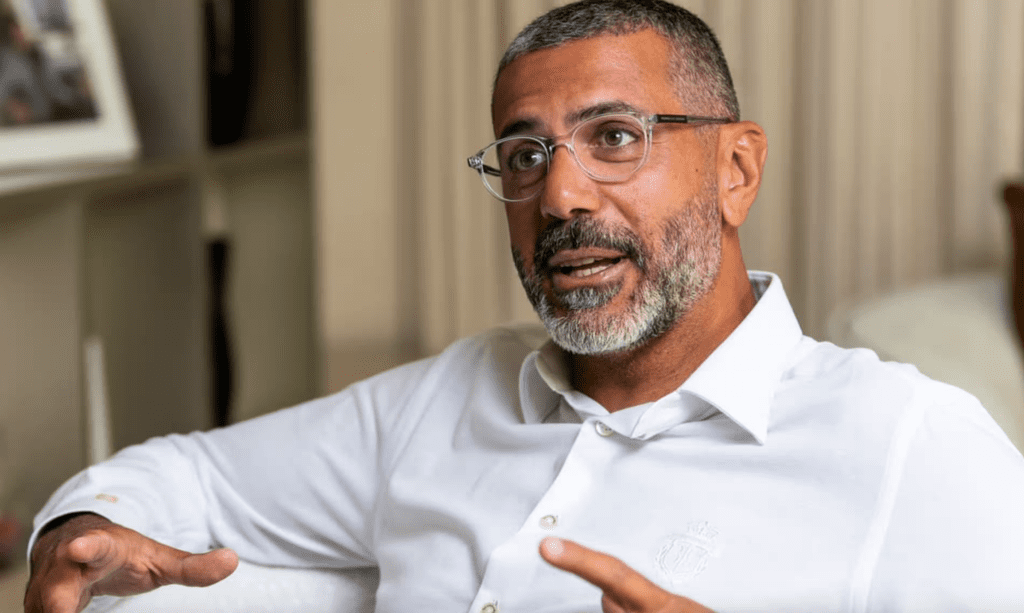
In its most basic form, Bassim Haidar’s company is a mobile platform that enables individuals without bank accounts to obtain credit. That’s the pitch, and it sounds humble. The reality of what Channel VAS—now renamed Optasia—became is much less modest: it is a global fintech company that serves underbanked people in Africa and other developing nations. It was recently listed on the Johannesburg Stock Exchange and sold to institutional buyers at valuations that put Haidar’s stake at well over a billion rand before he reduced his position.
Due to his Lebanese and Nigerian ancestry, Haidar was able to create a bridge that connects institutional finance and West Africa’s mobile economy in a way that neither country has discovered on its own. With mobile adoption significantly outpacing traditional banking infrastructure, the underbanked population in sub-Saharan Africa is not a niche; rather, it is a structural element of how financial services expanded throughout the continent. Through mobile networks, airtime credit and microfinance solutions fill a void left by traditional banks’ inability or deliberate refusal to do so. In order to gain scale, Optasia positioned itself in that gap early on.
For the first time, the company had a public profile and an independently observable valuation thanks to the JSE listing. At the time of the IPO, Haidar owned about 19% of a company that the market had valued at a significant size. After that, he sold more than 74 million shares to FirstRand, one of the biggest banks in South Africa, which decreased his ownership to about 1.5 percent and brought in more than R1.48 billion. Although it wasn’t a complete exit, the move was a huge liquidity event that turned a sizable amount of paper riches into realized gains.
That trajectory is reflected in his estimated net worth of $400 million, which is made up of the remaining Optasia shares, the revenues from share sales, and the larger portfolio of investment, fintech, and telecommunications assets he has amassed. Accurately valuing private entrepreneurs operating in emerging markets is a well-known challenge. Haidar’s fortune consists of a variety of stakes, properties, and assets that aren’t marked to market on a daily basis, in contrast to a publicly traded CEO whose net worth varies in real time with a stock price. The $400 million amount is not a verified ledger; rather, it is the best estimate currently available.
There is a wide range of assets outside of the main business. Haidar owns a Gulfstream G550, one of the more powerful long-range private aircraft available, which is frequently spotted at airports in Africa, Europe, and the Middle East when negotiating deals that call for mobility. With the 56-meter Benetti superyacht, Bash, he joins a select group of people around the world for whom a ship of that caliber is a useful rather than merely symbolic purchase. Purchased for about £42 million, the One Hyde Park flat in London places him in one of the world’s most scrutinized luxury residential buildings, a Knightsbridge development that has accommodated enough notable foreign buyers to serve as an unofficial register of significant wealth.
