

There’s a photo making quiet rounds among football fans. Stephen Eustaquio, still in his Canada jersey, carrying a small child past a crowd of supporters and family members after a World Cup group stage match. The picture doesn’t demand attention. It doesn’t need to. His expression conveys more than a caption could.
At just over a year old, Benedita, his daughter born in April 2024 and named in the Portuguese Catholic tradition, is already the most significant individual in her father’s life.
It’s worth taking a moment to consider that. Eustaquio has represented Porto in more than a hundred games. At the 2026 FIFA World Cup, he scored the game-winning goal against South Africa in the 92nd minute with a calm low volley that shocked the entire country. He is regarded as one of the most significant football players in Canadian history. And yet, when the microphone found him after that South Africa match, he didn’t talk tactics. He said everything he does is for his family — his fiancée, his daughter, his brother, the people back home.
Benedita arrived in April 2024, to Eustaquio and his partner Constança Damião, a Portuguese fashion designer who founded her own clothing brand. In May 2025, the couple became engaged. By the time they were celebrating their engagement, Eustaquio had already been a father for over a year — already learning, as most new parents do, that nothing in professional life quite prepares you for the weight of holding your own child.
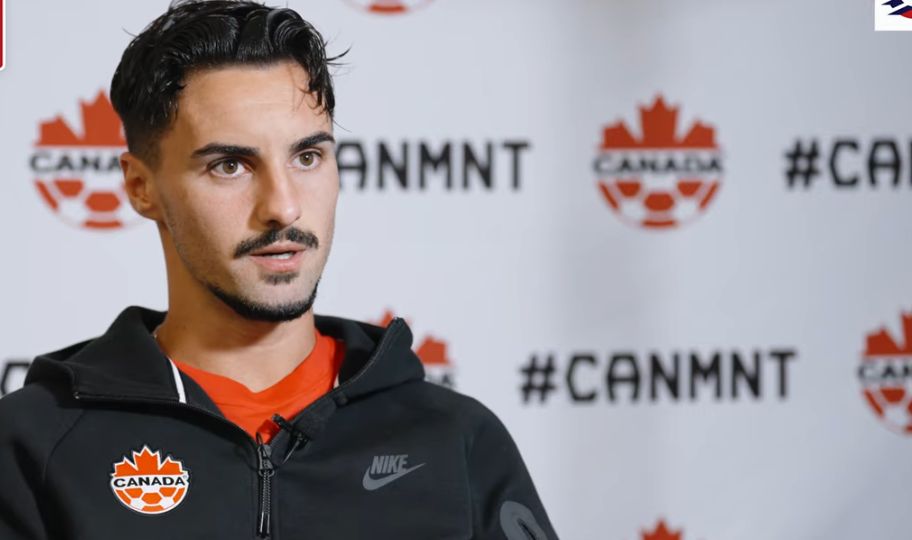
The timing of Benedita’s arrival is what gives it such significance. She was born during a time when Eustaquio was going through one of the most difficult periods of his life. In 2023, Esmeralda, his mother, passed away from brain cancer. In 2024, Armando, his father, died of a heart attack. Within thirteen months of one another, both parents passed away. People are hollowed out by this type of loss. And a daughter showed up somewhere in the midst of that sorrow.
The way life keeps giving you reasons to keep going, even when the burden seems insurmountable, has an almost subdued extraordinary quality. Mauro, Eustaquio’s brother and coach at Inter Toronto in the Canadian Premier League, has been candid about the significance of their parents to them both. Without complaining, their mother drove for matches for hours. Esmeralda filled in as their father’s on-field translator while he was coaching youth teams in Canada, even though he didn’t speak English at the time. This wasn’t because she was asked, but rather because she saw her family and thought, “How can I help them be happy?” Love like that never fades. It just passes forward.
It’s possible that Eustaquio sees something of his own parents when he looks at Benedita — that the same quiet devotion his mother showed him is now what he’s trying to give his daughter. He grew up shaped by two people who worked brutal hours by Lake Erie, his father out before dawn on a fishing boat, his mother starting her factory shift at six in the morning. They never skipped a training session. They never missed a game. That’s a big deal.
Watching Eustaquio carry Benedita through the crowd after a World Cup match, past the noise and the flags and the cameras, there’s a sense that this is what the whole journey has been pointing toward. Not just a goal in stoppage time. Not just a spot in the Round of 16. Something less noisy than that. One day, a daughter will watch the video and gradually realize what her father was carrying when he ran toward that net.
Benedita is a year old. She won’t recall the World Cup in 2026. However, Stephen Eustaquio will recall precisely who he was playing for.
