

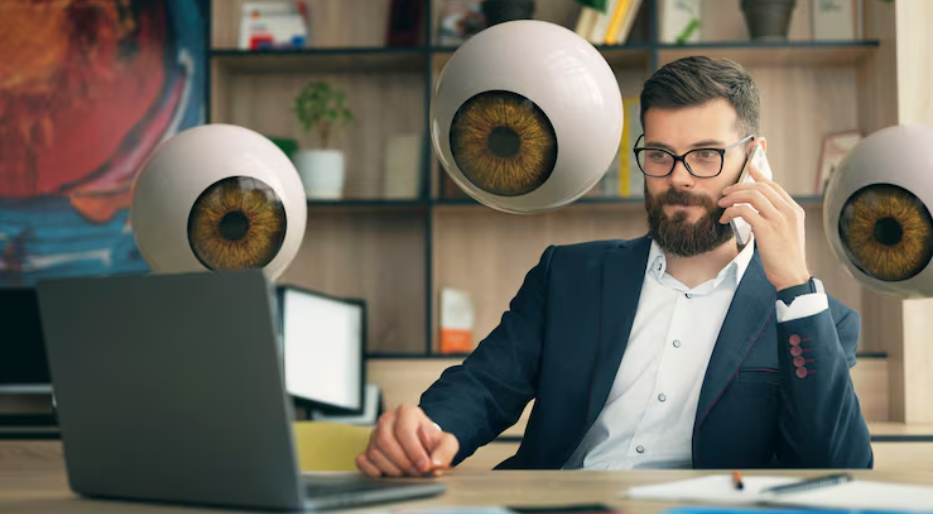
There comes a time when you realize the laptop your company shipped to your door was never truly yours. Many remote workers have experienced this. Perhaps with a happy onboarding note tucked inside, it arrived in a tidy box. However, software was secretly installed in the background before it ever left the warehouse, monitoring every keystroke you made, every website you visited, and every moment your mouse remained motionless. You were simply unaware of it at the time.
That is the unspoken reality of bossware in 2025, and it has advanced far beyond simple keystroke logging. These days, real-time eye-tracking alerts, webcam-based facial recognition, and AI systems that give employees a daily “risk score” based on the emotional tone of their Slack messages are all commonplace. It sounds like something from a dystopian movie with a moderate budget. It’s not.
| Category | Details |
|---|---|
| Topic | Employee Monitoring Software (Bossware) |
| Also Known As | Tattleware, Employee Monitoring Applications (EMAs) |
| Key Companies | Veriato, RemoteDesk, Prodoscore, Kickidler, Teramind, Spyera, Flexispy |
| Adoption Rate | 60% of US employers with remote staff use some form of monitoring software (Digital.com, 2021) |
| Pandemic Impact | Usage surged from 16% (April 2020) to 26% (June 2020) among HR leaders (Gartner) |
| Legal Status (US) | Legal in most states; few states require disclosure to employees |
| Legal Status (UK/EU) | Better protections exist under data privacy law, but enforcement is weak |
| Key Concern | Invasion of home privacy, psychological harm, algorithmic bias |
| Reference | The Guardian – Bossware Investigation |
Consider a young supply chain analyst who worked for a major US retailer. The journalists who interviewed him called him James. He thought his years of strong performance would speak for themselves when the pandemic forced him to work from home.
His team was then called to a video conference one day and informed that there were gaps in their work. times when the database is not used. Later on, James found out that the business had been secretly monitoring his keystrokes the entire time.
The surveillance itself wasn’t what made it worse. It was that his job’s purpose was entirely overlooked by the data. He spent the majority of his time on calls with couriers and vendors, none of which appeared in a keystroke count. “They looked at the individual analysts almost as if we were robots,” he later remarked. It’s difficult to ignore how painful that is.
This type of measurement has been the foundation of entire business models for companies such as Prodoscore, which was established in 2016. Every day, their software assigns a score of 100 to each employee based on their usage of databases, messaging apps, phones, and email. Like a report card, that score arrives in the manager’s email every morning.
Approximately 50% of businesses that use Prodoscore don’t even bother to inform their staff about the program. According to the CEO, it’s “employee friendly.” Employees who are aware of it use different terminology.
Veriato goes one step further by using artificial intelligence (AI) to analyze employee emails and chat messages in order to determine their sentiment and identify anyone whose tone of voice conveys “disgruntlement.” You are put under closer scrutiny if the algorithm determines that you sound dissatisfied enough to pose a security risk.
The CEO of the company, Elizabeth Harz, presents it as safeguarding all parties. That might actually be the goal. However, it seems worthwhile to closely examine the gap between intention and effect, particularly when the technology is making assumptions about people’s inner lives based on the language they use in a 9 a.m. Slack message.
Then there is RemoteDesk, a product that uses object detection and facial recognition to monitor remote workers via their webcams in real time, making sure that no phone or unauthorized person looks at the screen.
If company policy prohibits eating on the job, it can set off alerts. At one point, the company claimed that its product guaranteed “work-from-home obedience.” Before it was subtly removed, that phrase generated a fair amount of outrage on the internet.
According to a survey of 1,250 US employers, 60% of those with remote workers were already using some kind of monitoring software, and nearly 90% of them had fired employees after implementing it.
A Canadian study of managers in Ontario, British Columbia, and Quebec found that the most common invasive tools in use included video surveillance and keystroke logging — and that a majority of the managers surveyed were still running the software even while acknowledging it damaged employee trust. Knowing something is corrosive but still choosing it is a specific type of institutional honesty.
On this point, psychological research is clear-cut. Being monitored reduces your sense of autonomy, explains Nathanael Fast, who studies the psychology of technology at the University of Southern California. Less autonomy translates into more stress and more anxiety.
Studies from the call center industry, which has been running surveillance experiments on workers for decades, show a direct line between intensive monitoring and psychological harm. In a depressing way, the call center is now the canary for the rest of the workforce.
There’s also a deeper problem with what these tools actually measure. Productivity scores use activity as a proxy for real output — but a worker coaching a junior colleague, or spending an hour on a nuanced vendor negotiation, generates almost no trackable digital traffic.
They are marked as idle by the algorithm. A researcher at the UC Berkeley Labor Center put it plainly: the systems give the appearance of objectivity, but that appearance is largely manufactured. They are measuring things that are simple to measure and then presenting the results as if they were accurate.
When Microsoft introduced its Productivity Score feature in late 2020, which evaluated each employee’s level of engagement across Teams, Outlook, and other apps, it discovered this the hard way. Microsoft apologized and redesigned the product in a matter of weeks due to the rapidity of the backlash.
However, smaller businesses have persisted in expanding into areas that Microsoft was unable to control. This software’s market is expanding.
Compared to a traditional office, bossware is especially problematic at home because it invades personal life. A webcam aimed at a remote worker’s desk could catch a glimpse of something never meant for an employer’s eyes, such as a baby crib, a medical device, or the face of a family member. That isn’t speculative.
These particular situations have been noted by privacy researchers. The legal and moral status of a home differs from that of an office, and technology hasn’t kept up with this difference. The majority of US states’ laws most definitely haven’t.
Basecamp co-founder David Heinemeier Hansson has been fighting the industry for years. He called the technology “inhumane” and prohibited bossware vendors from integrating with Basecamp’s software early in the pandemic.
He doesn’t think his position will change the market. But the question he keeps raising is worth sitting with: if you’re surveilling 100 people to catch one person slacking off, what are you doing to the other 99?
James, the analyst who found out his keystrokes had been counted without his knowledge, was still looking for a new job the last time anyone checked. He called the monitoring culture at his company “toxic.” Bossware may have never gotten a more honest review than that.
